About the Philippine Institute of Architects

Asia's oldest architectural society, founded in 1933.

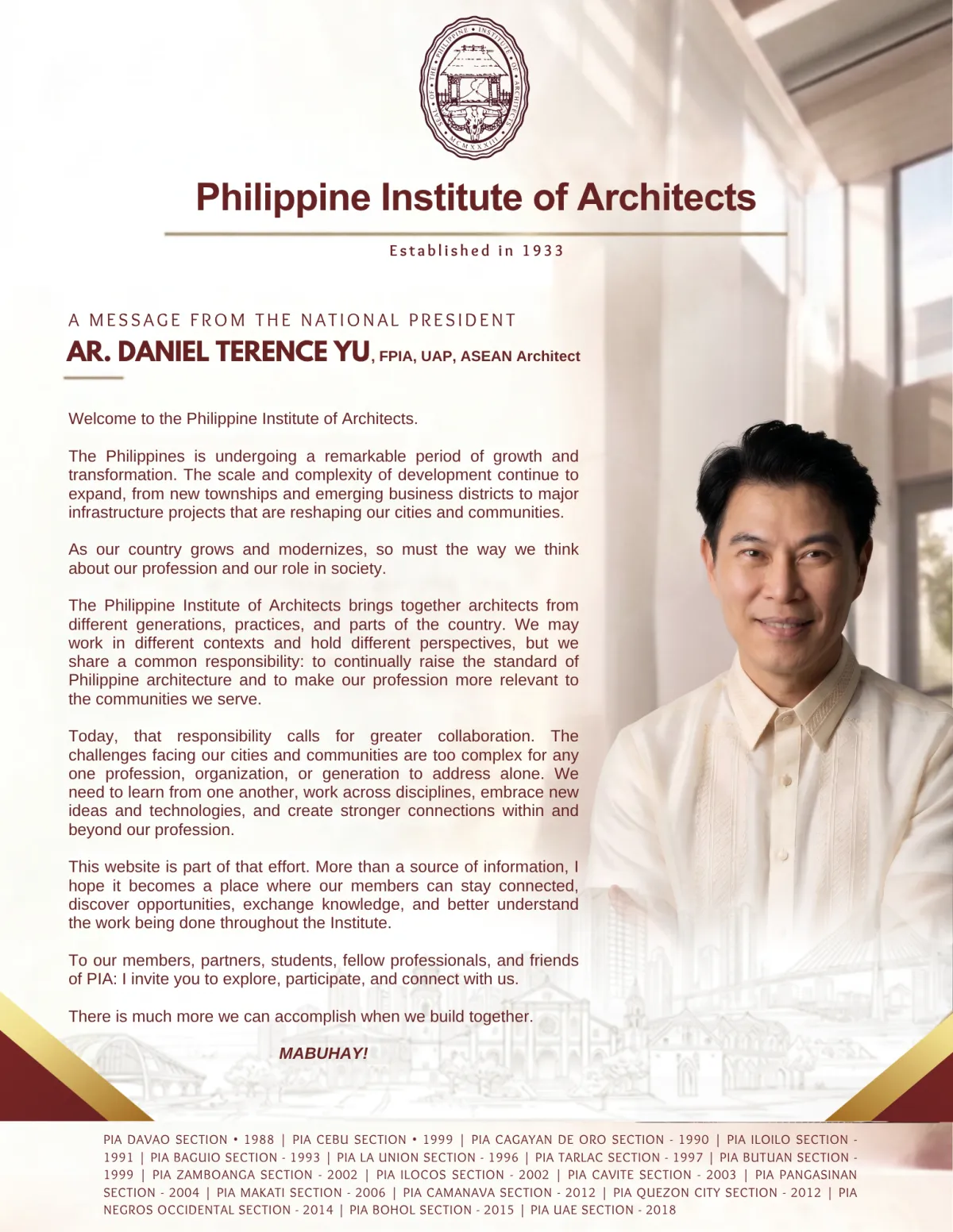
Message from the National President:

PIA National President (2025-2027)

Ar. Daniel Terence O. Yu is a leading figure in Philippine architecture, known for advancing smart, human-centered design that responds to the evolving needs of cities and communities. As President & CEO of VISIONARCH, he has helped elevate the firm to international recognition, including its inclusion in the WA100 and BCI Asia Top 10, while leading landmark projects such as One Ayala and Parqal. 

As National President of the Philippine Institute of Architects for 2026–2027, Ar. Yu champions a profession that is globally competitive, socially responsive, and firmly rooted in resilience. Guided by the belief that “Every building carries the promise of a better life,” his leadership connects professional practice, policy advocacy, and education in service of a more sustainable built environment. 

Beyond practice, he mentors future architects in advanced design, drawing on his Master’s in Architectural Management and Design from IE Madrid. His work as both practitioner and academic reflects a long-standing commitment to shaping the next generation of visionary, ethical, and community-minded designers. 

With his expertise spanning smart urban spaces, transit-oriented development, digital design innovation, and architectural management, Ar. Daniel Terence O. Yu has successfully elevated VISIONARCH’s global profile through dedicated professional and academic leadership. His steadfast advocacy for resilient, human-centered design, his work actively shapes the built environment through forward-thinking projects that drive progress, enhance sustainability, and improve the quality of life across diverse communities.

Ar. Daniel Terence O. Yu, FPIA, UAP, ASEAN Architect 

President & CEO, VISIONARCH | National President,

Philippine Institute of Architects (2025–2027) 

Building a Nation: The 93-Year Legacy of the Philippine Institute of Architects 

The architectural history of the Philippines is a narrative that stretches far beyond the establishment of modern regulatory bodies, rooted deep in the ingenuity of indigenous builders known as Anluwagi. Long before the advent of modern certification, these master builders utilized indigenous, sustainable materials such as bamboo, timber, and limestone to create structures that adapted perfectly to the local climate. Notable engineering feats, such as the Rice Terraces of the Cordillera and the intricate Torogan residences of Mindanao, stand as evidence of a precolonial mastery of environment and joinery. During the Spanish colonial era, this tradition evolved as Filipino builders, recognized as Maestro de Obras, took the lead in constructing the stone fortifications and Catholic churches that would become the cornerstones of local urban identity. 

The transition to the 20th century introduced new influences, most notably through the American colonial administration. This era brought about the Pensionado program and the creation of the Bureau of Architecture in 1901, which helped standardize building construction practices. A pivotal moment in this professional trajectory occurred in 1921 with the passage of Act No. 2985, the Engineering & Architecture Law. This landmark legislation established the Board of Examiners for Architecture and mandated formal licensure, with Tomas Mapua becoming the first registered architect in the country, holding License No. 1. 

On January 19, 1933, the formal unification of the profession was realized when visionary practitioners founded the Philippine Architects Society (PAS) at the mansion of Juan Felipe Nakpil. With Juan Felipe Nakpil serving as the organization's president and Tomas B. Mapua as its vice president, the society established a fellowship that would grow in scope and influence. Officially rebranded as the Philippine Institute of Architects (PIA) in 1945, the organization stands today as a pillar of design excellence and the oldest active architectural society in Asia. This institutional growth accelerated following the devastation of World War II, as the PIA played an integral role in post-war reconstruction, leading the Capital Planning Commission to oversee the recovery of Manila and spearheading designs for major infrastructure such as the Veteran’s Memorial Hospital. 

The PIA's commitment to the profession extends far beyond national shores. From 1950 to 1991, the PIA proudly represented the country on the global stage as the official Philippine Section and a founding member of the Union Internationale des Architectes (UIA), carrying this premier international membership for over four decades. Domestically, the legal and ethical framework of the profession was further solidified by the passage of Republic Act 545 in 1950. As the decades passed, the PIA continued to evolve, eventually helping to found the United Architects of the Philippines (UAP) in 1975 to foster broader professional collaboration. 

Today, the PIA maintains a strong commitment to service, evidenced by heritage conservation initiatives like the documentation of Gabaldon School Houses and the restoration of the Manila Post Office, alongside urban planning projects centered on the rehabilitation of the Pasig River. The Institute has secured its physical legacy through the establishment of the PIA Center in Pasig, a permanent hub featuring a dedicated architectural museum and a comprehensive archive. Following a landmark 2024 Supreme Court decision affirming that only registered and licensed architects may sign and seal architectural plans, the Institute is now charting a clear path toward its 2033 Centennial. Under the leadership of National President Daniel Terence Yu, the PIA continues to unite the nation’s most dedicated design professionals, drafting the blueprints for the future of Filipino communities and remaining anchored in its 93-year history of nation-building through design.

Historical Timeline of the PIA

  • 1850s: Felix Rojas y Arroyo returns from studies abroad to become the first recognized Filipino architect during the Spanish Era.

  • 1902: The Academia de Arquitectura y Agrimensura de Filipinas (AAAF) is established as the first organization for Master Builders and Surveyors.

  • 1921: The Philippine Assembly passes Act 2985, establishing the first licensure examination, making Tomas Mapua the first registered professional architect.

  • 1933: The Philippine Architects Society (PAS) is founded on January 19 at the mansion of Juan Felipe Nakpil.

  • 1934: Mercedez Raffinan becomes the first registered female architect in the country.

  • 1945: Following World War II, the society officially amends its name to the Philippine Institute of Architects (PIA).

  • 1950: The PIA awards its first Gold Medal of Merit to Andres Luna de San Pedro.

  • 1953: The PIA officially joins the Union Internationale Des Architectes in France.

  • 1962: The PIA collaborates to draft the first Architects' National Code.

  • 1972: The first PIA College of Fellows is formed and holds its first investiture rites.

  • 1975: The PIA co-founds the United Architects of the Philippines (UAP) alongside two other architectural organizations.

  • 1983: The PIA celebrates its 50th Anniversary under its first woman president, Imelda Borromeo Cancio.

  • 2005: The PIA is instrumental in drafting and passing the new Architects Law, R.A. 9266.

  • 2021: The PIA launches the Centennial Year of the Architecture Profession in the Philippines to mark 100 years since Act 2985.

  • 2023: The PIA marks its 90th anniversary and signs a partnership to restore the fire-damaged Manila Central Post Office.

  • 2024: A milestone Supreme Court decision affirms that only registered and licensed architects may prepare, sign, and seal architectural plans.

Distinguished Members & Pioneers

  • Juan Felipe Nakpil: Founding President of the PAS/PIA in 1933, first Chancellor of the PIA College of Fellows, and the first recipient of the National Artist of the Philippines Award in Architecture (1972).

  • Tomas B. Mapua: Founding Vice President, the second President of the society (1935), the Philippines' first registered professional architect (License No. 1), and founder of the Mapua Institute of Technology.

  • Carlos Alejandro Barretto: Co-founder who coined the original name "Philippine Architects Society" and was the first Filipino recognized as an architect during the American Insular Government.

  • Andres Luna de San Pedro: Recipient of the very first PIA Gold Medal of Merit in 1950.

  • Jose Ma. Zaragoza: PIA President, Gold Medal of Merit awardee, Order of the National Artist in Architecture recipient, and co-composer of the PIA March.

  • Leandro V. Locsin: Elected as the youngest-ever PIA president in 1966 and the first and only recipient of all major Philippine architectural awards, including the Order of the National Artist.

  • Imelda Borromeo Cancio: The first woman president of the PIA, leading the institute during its 50th Anniversary in 1983.

  • Carlos Arguelles: PIA President during the 1958 Silver Anniversary and 1988 Gold Medal of Merit Awardee.

  • Gold Medal of Merit Laureates: Additional distinguished laureates noted for shaping the nation's skyline include William Coscolluela, Roger Villarosa, Carmelo Casas, Jose Pedro Recio, Francisco "Bobby" Mañosa, and Jose Mañosa.

Our Vision

"To be the unifying force for architectural excellence in the Philippines, fostering a global standard of practice that honors our cultural heritage while embracing technological innovation."

Our Mission

"Dedicated to elevating the standards of the profession, promoting ethical practice, protecting the role of the architect, and actively contributing to nation-building through the built environment."

Our Objectives

  • To unite, on a democratic basis, the architects of the Philippines, to strengthen the bonds of friendship, as well as the intellectual, artistic, scientific and professional ties between architects of all countries, schools and philosophies;

  • To maintain unrestricted contact between architects of all Region irrespective of national and political frontiers;

  • To represent the profession to international level and, where appropriate, to formulate official statements for the consideration of international organizations in their activities in so far as these involve the function of the architect;

  • To maintain public confidence in the integrity and the ability of architects by demanding from members of the Institute the highest moral and professional standards;

  • To develop progressive ideas in the fields of architecture as well as their practical application for the welfare of the community;

  • To define and redefine whenever necessary, the functions of the architect in a changing world, and his widening role in the building and planning team;

  • To encourage the association of architects with other disciplines, professions and interests involved in building and planning in highly fields, and to stress the value of the work of the architect;

  • To encourage action aimed at introducing the ideas of awareness of space and of three-dimensional form, at all stages of general education and to promote all means to this end;

  • To see, that the social and cultural interest of the architect are recognized by the public and by official and semi-official bodies and that architecture complements such functions;

  • To encourage in each Region the protection of the rights and status of the architect and the recognition of his function in society;

  • To promote and encourage the development of architectural education in all its aspects, and facilitate international exchange of architects, researchers and students;

  • To make the profession of ever-increasing service to society.

Our Leadership

The National Board of Directors

The Philippine Institute of Architects is guided by a distinguished body of practitioners committed to advancing the profession. Our National Officers lead with a deep respect for our 93-year heritage and a forward-looking vision for the future of the built environment.

National Board of Directors (Year 2026 - 2027)

  • National President: Ar. Daniel Terence O. Yu

  • Vice President for Administration: Ar. Jose Pedro Recio, FPIA 

  • Vice President for Professional Practice: Ar. Abelardo M. Tolentino Jr., FPIA 

  • Vice President for Public Affairs: Ar. Frederick R. Sibug, FPIA 

  • National Secretary: Ar. Ma. Cynthia S. Naval, FPIA 

  • National Treasurer: Ar. Mylene P. Isidro, FPIA 

  • National Directors:  

    Ar. Germain M. Ang, FPIA 

    Ar. Hunson L. Co, FPIA 

    Ar. Maria Cecilia C. Vega, FPIA 

  • NCR District Director: Ar. Ma. Lynn S. Del Rosario, FPIA 

  • Central Luzon District Director: Ar. James Dale B. Miranda, FPIA 

  • South Luzon District Director: Ar. Adonis Vie T. Crizaldo, FPIA 

  • North Luzon District Director: Ar. Joselito R. Miranda, FPIA 

  • Visayas District Director: Ar. Isabel A. Garcia, FPIA 

  • Mindanao District Director: Ar. Romeo L. Dela Cruz, FPIA

  • Immediate Past President/Chancellor - College of Fellows: Ar. Carmelo T. Casas, FPIA 

PIA Presidents 

Since its founding in 1933, the PIA have elected among its members and sections, 5 architects as president of the organization.

  1. Juan Felipe Nakpil

  2. Tomas Mapua

  3. Pablo Antonio

  4. Fernando Ocampo

  5. Juan Marcos Arellano

  6. Cesar Concio

  7. Andres Luna de San Pedro

  8. Gines Rivera

  9. Jose Ma. Zaragoza

  10. Carlos Da Silva

  11. Edmundo Lucero Francisco Fajardo

  12. Carlos Domingo Arguelles

  13. Otilio Arellano

  14. Antonio Sindiong

  15. Felipe Mendoza

  16. Leandro Locsin

  17. Antonio Dimalanta

  18. Jesus Bondoc

  19. Manuel Mañosa,Jr.

  20. Gabino De Leon

  21. Ariston Nakpil

  22. Adolfo Benavidez

  23. Cesar Canchela

  24. Arturo Mañalac

  25. Nicasio De Venecia

  26. Carlos Santos Viola

  27. Paulino Lim

  28. Imelda Cancio

  29. Macario Pagdanganan

  30. Faustino Ramon

  31. Jessie Cayanan

  32. Nepthaly Del Rosario

  33. Ernesto Antonio Masol

  34. J. Paul Octaviano

  35. Delfin Viola III

  36. Rogelio Villarosa

  37. Manuel Go, Sr.

  38. Francisco Flameno

  39. Nicodemes Pagulayan

  40. Augusto Galang

  41. Remigio Abello

  42. Orlando Villarin

  43. Delfin Pantangco, Jr.

  44. Angelito Antonio

  45. Alvin N. Vega

  46. Joel Vivero Rico

  47. Pablito Labao, Jr.

  48. Ma Cynthia S. Naval

  49. Renato Basa

  50. Frederick R. Sibug

  51. Carmelo T. Casas

  52. Daniel Terence O. Yu

PIA Section Presidents 

  • PIA Baguio Section: Ar. Francisco Que, Jr., PIA

  • PIA Bohol:

  • PIA Butuan Section: Ar. Marlon Azarcon, PIA

  • PIA Cagayan de Oro Section: Ar. Jermaine Royce L. Petalcorin, PIA

  • PIA CAMANAVA Section: Ar. Francis Ivan Zuñiga, PIA

  • PIA Cavite Section: Ar. Asuncion B. Bilono, FPIA

  • PIA Cebu Section: Ar. Litz Evan Bravo, PIA

  • PIA Davao Section: Ar. Jee Rose Calderon-Jamandre, PIA

  • PIA Ilocos Section: Ar. Xeth Karlo Bielza, PIA

  • PIA Iloilo Section: Ar. John Michail S. Garcia, PIA

  • PIA La Union Section: Ar. Marlon Niduaza, FPIA

  • PIA Makati Section: Ar. Maria Lynn Santos Del Rosario, FPIA

  • PIA Manila Section:

  • PIA Negros Occidental:

  • PIA Pangasinan Section: Ar. Lester V. Garcia, PIA

  • PIA Quezon City Section: Ar. Christian Joy Recio, PIA

  • PIA Tarlac Section: Ar. Andry M. Nacpil, PIA

  • PIA UAE Section:

  • PIA Zamboanga Nakpil Section: Ar. Maria Angela S. Tanjusay, PIA

Distinguished Members  

Gold Medal of Merit Awardees 

The Philippine Institute of Architects (PIA) Gold Medal of Merit Award holds the distinction of being the first architectural award in the Philippines. While the PIA was founded in 1933, discussions for a recognition program began in the early 1940s during the term of PIA President Juan Marcos Arellano to honor members with an exemplary body of work.

 The award was formally approved by the PIA National Board in 1949, drawing inspiration from a similar award given by the American Institute of Architects. A discerning jury of PIA Fellows is responsible for selecting the awardees. The physical medal, designed by architect Adolfo Benavidez and first fabricated by El Oro engraving in Quiapo, Manila, integrates classical architectural elements with the PIA logo and iconic local imagery, specifically featuring a Filipino triumphal arch framing the Mayon Volcano and a carabao skull adorned with sampaguita garlands to symbolize Filipino identity, beauty, and grace. 
 Below is the list of the distinguished 26 members of the PIA who have received the Gold Medal of Merit Award from 1950 to 2022.

  1. Andres Luna de San Pedro 

  1. Juan Felipe Nakpil 

  1. Tomas B. Mapua 

  1. Fernando M. Ocampo 

  1. Antonio M. Toledo 

  1. Carlos Da Silva 

  1. Juan Marcos Arellano 

  1. Cesar Concio 

  1. Leandro V. Locsin 

  1. Jose Ma. Zaragoza 

  1. Carlos Domingo Arguelles 

  1. Carlos Santos Viola 

  1. Maximo Vicente, Jr. 

  1. Antonio Sindiong 

  1. Cristobal A. Espina 

  1. Manuel Go, Sr. 

  1. Paulino V. Lim 

  1. Maurilio R. Garcia 

  1. Angel E. Dela Cruz 

  1. Ramon Ma. Zaragoza 

  1. William V. Coscolluela 

  1. Rogelio G. ViIlarosa 

  1. Jose Pedro C. Recio 

  1. Carmelo T. Casas 

  1. Ramon Orlina, Jr. 

  1. Jose P. Mañosa 

ACCREDITED BY:

CONTACT US

Landline No.: (02) 8890-4738

Mobile No.: 0917-315-1042 or 0917-537-6682

Secretariat Office Address: 2/ F Cordero South Bldg., 2677 South Ave.,

Cor. San Joaquin St., Olympia, Makati City, 1207

Website: pia-architects.com

Office Address: Makati City

Copyright © 2026 | Philippine Institute of Architects

Powered by: Digifixhub